'/%3E%3C/svg%3E)
'/%3E%3Cpath%20fill='%23b2b2b2'%20d='M241%20382q0%2016%2017%2026%2017%2011%2042%2011t42-11q16-11%2017-26V269H241'/%3E%3Cpath%20fill='%239f7e00'%20d='M241%20379q0%2014%208%2023%209%209%2021%209%2014%200%2021-9%209-9%209-23V269h-59'/%3E%3Cpath%20d='M241%20339v-70h59v110q0%2014-9%2023l-6%205v-68h-15v72q-8%200-14-4v-68zm59%2040c0%2022%2015%2032%2029%2032%2021%200%2030-18%2030-32v-40h-59'/%3E%3Cpath%20fill='%239f7e00'%20d='M266%20277v5h2v12h-3v-5h2v-5h-9v5h2v5h-4v9h3v18h-5v10h34v-10h-5v-18h3v-9h-4v-5h2v-5h-9v5h2v5h-3v-12h2v-5zm42%20101q0%2010%206%2017%206%206%2015%207%2010-1%2016-7%206-7%206-17v-29h-43'/%3E%3Ccircle%20fill='%230044ad'%20cx='329.5'%20cy='372'%20r='6'/%3E%3Cellipse%20fill='%230044ad'%20cx='300'%20cy='340'%20rx='16'%20ry='21'/%3E%3C/svg%3E)


Camp Blog
Five reasons to learn Español
17th September 2018
Camp Suisse is a truly international environment and every year we welcome a number of Spanish speakers. Over the last few years, Camp Suisse’s Spanish language course has been growing steadily in popularity; on a global level, Spanish is becoming more widely spoken. So we thought it would be a good idea to have a look at the top five reasons to hablar español:
1. Increasing numbers of Spanish speakers
In the US, Spanish is rising ahead of any other non-English language at a rapid pace, with a steady flow of new immigrants from Latin America and growth in the already large Hispanic population.
According to a Pew Research Center report, an estimated 37.6 million people in the US spoke Spanish as their first language in 2013 and analysts predict the Latino population will reach approximately 128.8 million by 2060.
Proportionally, Hispanics will rise from around 16 per cent of the US population in 2010 to 30 per cent by 2050.
2. Learning Spanish will help your career
With booming economies in Latin America, employers are desperate for people who speak Spanish. There is a huge demand in the west, particularly North America, for Spanish-speakers in nursing, construction management and media, among many other positions.
Big corporations are realising the importance of reaching a market that represented $1.5 trillion (£1.13 trillion) in purchasing power in the US in 2015. Meanwhile, Latin America received a record $174 billion of foreign investment in 2012 and companies everywhere are expanding there, such as PepsiCo, which announced a $5 billion investment in Mexico in January 2014.
3. It will unlock a world of travel destinations
There are approximately 329 million native Spanish speakers in the world and they populate some of the coolest destinations in the world.
Even if you do go to popular destinations in Mexico and the Caribbean, speaking the local language will help you get off the beaten path and see some real culture. And then of course you can book a trip to Spain and see the wonders of Barcelona, Madrid, Andalucia and more.
4. You can enjoy amazing books and movies
Around 100 successful authors from 54 countries voted El ingenioso hidalgo Don Quixote de la Mancha by novelist Miguel de Cervantes as the best book of all time and while the 17th-century book is widely available in other languages, it, like any book, is best in its original language.
Other Spanish-language authors you’ll want to read are Chilean poet Pablo Neruda – many of whose works have not been translated – Gabriel García Márquez, Roberto Bolaño, Mario Vargas Llosa and many more.
And then there are the movies. Star directors Pedro Almodóvar, Alfonso Cuaron and Guilermo Del Toro – who all have movies in their native language – should be enough to convince you of the richness of Spanish-language cinema.
5. Spanish is easy to learn
Written Spanish is almost completely phonetic – look at any Spanish word and you can tell how it is pronounced.
While mastering the grammar of Spanish can be a challenge, basic grammar is straightforward enough and many vocabulary words are similar to English. Since the number of Spanish speakers in the US continues to rise, chances are it will become even easier to learn and practice this language.
To find out more about our Spanish language tuition, head over to our languages pages.
Why Learn French…
6th September 2018
Located in the heart of Francophone Switzerland, here at Camp Suisse we strongly believe the ability to be conversant in the French language is a highly desirable ‘soft skill’; that is one which helps with inter-cultural communication in both professional and social environments. But we didn’t want to stop there: here are ten great reasons to learn French:
1. It’s a World Language
More than 220 million people speak French on the five continents. The OIF, an international organisation of French-speaking countries, comprises 77 member States and governments.
French is also the only language, alongside English, that is taught in every country in the world. France operates the biggest international network of cultural institutes, which run French-language courses for close on a million learners.
2. It’s a Language for the Job Market
The ability to speak French and English is an advantage on the international job market. A knowledge of French opens the doors of French companies in France and other French-speaking parts of the world (Canada, Switzerland, Belgium, and the continent of Africa). As the world’s fifth biggest economy and third-ranking destination for foreign investment, France is a key economic partner.
3. The language of culture
French is the international language of cooking, fashion, theatre, the visual arts, dance and architecture. A knowledge of French offers access to great works of literature in the original French, as well as films and songs. French is the language of Victor Hugo, Molière, Léopold Sendar Senghor, Edith Piaf, Jean-Paul Sartre, Alain Delon and Zinedine Zidane.
4. A language for travel
France is the world’s top tourist destination and attracts more than 79,5 million visitors a year. The ability to speak even a little French makes it so much more enjoyable to visit Paris and all the regions of France (from the mild climes of the Cote d’Azur to the snow-capped peaks of the Alps via the rugged coastline of Brittany) and offers insights into French culture, mentality and way of life. French also comes in handy when travelling to Africa, Switzerland, Canada, Monaco, the Seychelles and other places.
5. A language for higher education
Speaking French opens up study opportunities at renowned French universities and business schools, ranked among the top higher education institutions in Europe and the world. Students with a good level of French are eligible for French government grants to enroll in postgraduate courses in France in the discipline of their choice and qualify for internationally recognised degrees.
6. The other language of international relations
French is both a working language and an official language of the United Nations, the European Union, UNESCO, NATO, the International Olympic Committee, the International Red Cross and international courts. French is the language of the three cities where the EU institutions are headquartered: Strasbourg, Brussels and Luxembourg.
7. A language that opens up the world
After English and German, French is the third most widely used language on the Internet, ahead of Spanish. An ability to understand French offers an alternative view of the world through communication with French speakers from all over the world and news from the leading French-language international media (TV5, France 24 and Radio France Internationale).
8. A language that is fun to learn
French is an easy language to learn. There are many methods on the market that make learning French enjoyable for children and adults alike. It does not take long to reach a level where you can communicate in French.
9. A language for learning other languages
French is a good base for learning other languages, especially Romance languages (Spanish, Italian, Portuguese and Romanian) as well as English, since fifty per cent of current English vocabulary is derived from French.
10. The language of love and reason
First and foremost, learning French is the pleasure of learning a beautiful, rich, melodious language, often called the language of love. French is also an analytical language that structures thought and develops critical thinking, which is a valuable skill for discussions and negotiations.
Plus, with Camp Suisse’s French Immersion programme, there’s never been a better opportunity to learn French and have fun at the same time. For more information, drop us an email: info@campsuisse.com
Off Up to the Mountain Refuge
12th July 2018
On Tuesday, the blue group kicked off the day with their language classes. They dedicated part of the lesson to prepare for the renowned Camp Suisse Talent Show, which took place on Wednesday night, where each language class presented their own act. Everyone was very excited to put into practice what they had learnt in class over the last two weeks! After a hearty lunch, it was time to head off for our walk towards the French/ Swiss border, situated a little further up the mountain. All the campers were very proud of their efforts; the walk was a challenge for all, and the fruits of their efforts were appreciated in the form of the spectacular view when they reached the summit. In the evening, our group had the chance to enjoy a well deserved and delicious meal prepared at camp. Finally, before bed, the everyone enjoyed munching marshmallows and chanting their favourite songs around the camp fire!
Evelyne, Group Leader & Teacher of French
(Translated by Phil, Administrator) View the original in French


Adventures in the Aqua Parc!
23rd June 2018
Situated at the eastern end of Lake Geneva in Bouveret, Aquaparc has been coined as a tropical oasis, which welcomes over 300,000 visitors each year. The parc boasts over a kilometre of water slides, which plunge into pools heated to 32C.
Adding to the excitement are three tropical-themed areas, along with several ‘water universes’. The first is dedicated to children, and is home to a pirate ship, wave pool and the ‘Fantastico’ water slide. The family universe is home to three water slides. If you’re feeling brave, the ‘Sensations’ universe caters to the thrill seekers. The outdoor universe commands stunning views over the surrounding mountains and Lake Geneva. Finally, for the ultimate way to de-stress is with a visit to the ‘Wellness’ universe, which features a tropical bath, jacuzzies, saunas, fitness facilities and massages.
With so much on offer, it’s perhaps little surprise that so campers enjoy unwinding in the Aquaparc; especially after having experienced our more physical excursions such as the visit to Glacier 3000. To find out more about the Aquaparc, visit the Aquaparc website
PM
Musée Olympique Lausanne
15th June 2018
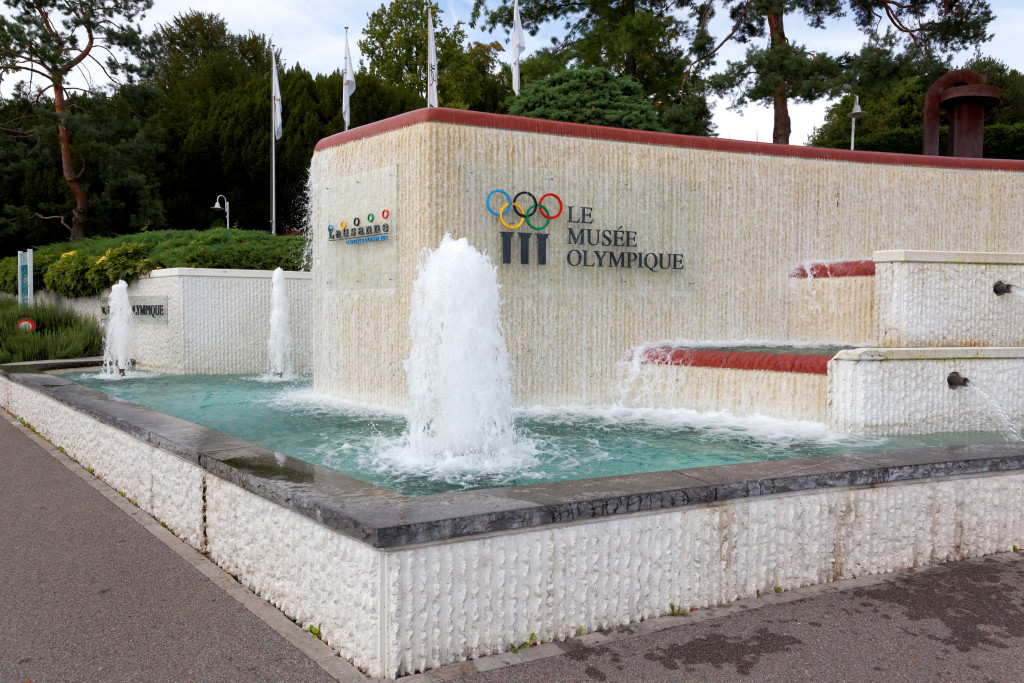
Founded in 1993, the Museum was the brainchild of then-president of the IOC Juan Antonio Samaranch. The project was overseen by Mexican architect Pedro Ramírez Vázquez, an International Olympic Committee member, and Jean-Pierre Cahen. The museum was named the European Museum of the Year in 1995.
The Museum’s permanent exhibition is organized into three major themes on three separate floors: Olympic World, Olympic Games, and Olympic Spirit. A visit begins on the third floor, where the Olympic World part of the exhibition informs visitors of the history of the ancient Olympic Games and the rebirth of the modern Games in the 19th century. Highlights include a display of Olympic torches, as well as videos documenting major moments in the history of opening ceremonies history.
The second floor focuses on Olympic Games. Sporting equipment for a variety of sports are on display, and visitors are introduced to the Youth Olympic Games and the Paralympic Games. More than 1,000 video clips of Olympic Games events and athletes can be searched and viewed at individual viewing stations.
The final part of the permanent exhibit covers the Olympic Spirit, where visitors are made to feel part of an Olympic Village and can test their balance, agility, and mental skills with interactive exercises. Olympic medals are also on display.
PM
Camp Suisse and the Chocolate Factory
11th June 2018
Our excursion to Cailler Chocolate Factory is arguably ever camper’s (and staff’s!) favourite excursion! The factory provides every visitor with a complete brand immersion experience; guiding them through the history of chocolate, which stems from the Aztec cocoa ceremonies, right through to the company’s current product range.
Visitors also experience full immersion of the chocolate making process, in the shape of an audio-visual tour, which shows how cocoa bean becomes chocolate bar. The past also comes to life through a selection of photographs that retrace the factory’s history from its humble origins in 1898 right up to the 1960s. This journey through time brings memories to life.
The very best is saved until last: with appetites whetted, visitors can then visit a specially designed shop which sells the entire range of Cailler of Switzerland chocolates.
More information about the factory can be found on their website: https://cailler.ch/en/maison-cailler/la-chocolaterie-suisse/
PM
The Dizzying Heights of Glacier 3000
5th June 2018
The excursion to Glacier 3000 is a highlight of any adventure to Camp Suisse. The glacier is the highest point of the Lake Geneva region, and is home to the only suspension bridge in the world connecting two mountain peaks. It is called Peak Walk by Tissot.
The bridge connects the smaller peak (View Point) with the 5 metre higher main peak (Scex Rouge) and takes all guests to incredible heights. The 107 metre long and 80 centimetre wide bridge offers a stunning view onto the Alps: the Matterhorn, Mont Blanc, Eiger, Mönch and Jungfrau are all visible from the bridge and offer grandiose views, far off into the distance. The suspension bridge is free of charge and open year-round subject to weather conditions.
Glacier 3000 also features a marked glacier trail, which runs from Scex Rouge to Quille du Diable and is open all year-round. The walk begins directly at the Scex Rouge mountain station. Those who prefer to take it a bit easier, can take the Ice Express chairlift to the glacier and can begin their walk in the snow from there.
Year after year, our campers enthuse over our dog sledding experience. The joy of the pack of dogs moving around in the snow is contagious, and felt by everyone watching them. The Huskies pull you through the beautiful glacier landscape and allow you to have a very special experience.
PM
The impact of foreign language study on young people
28th February 2018
Here at Camp Suisse we believe that providing fun and dynamic language classes for our campers is really important and adds great value to the camp experience. We make use of some amazing and passionate native speakers who come from far and wide in Europe, including Granada, Montpellier and south Germany. We create an authentic, diverse and invaluable cultural experience for our young campers.
So why are languages and cultural awareness just so important? If you’re not sure – then read on.
Intelligence and Success
- Languages are challenging and young minds are very impressionable – meaning it’s much easier to learn while young.
- Studies have shown that learning another language improves cognitive skills therefore improving a young person’s capacity to learn in general.
Social Skills
- Exposure to new and challenging experiences develops a child’s confidence and teaches them that they are capable of more than they may have known, and more than they are comfortable with.
- The understanding of culture that accompanies the study of a language helps children to become more empathetic, more socially aware and more flexible to different situations.
Professional Advantages
- In an increasingly globalized economy, it is invaluable for international companies to have employees who are not only accomplished in their discipline, but who can express and share their knowledge in another language.
- The ability to negotiate and debate in a foreign language adds great strength to a CV or professional portfolio.
We don’t know about you, but we are definitely convinced!

How to keep your loved ones entertained, inspired and active over the summer holidays – Camp Suisse Day Camps
12th January 2018
Here at CS HQ, we are very excited to announce the introduction of our Day Camps for summer 2018. It is now even easier (and cheaper) to enjoy the Camp Suisse experience on a part time basis.
Whether it is for a morning, afternoon or a full day, you can sign up for a wide range of activities under the expert guidance of Camp Suisse staff and have the opportunity to mix with children from all over the world.
As with the well-established residential program at Camp Suisse, the aim is to help our campers build confidence and learn new skills in the safest possible environment. Our team has spent many years developing an Alpine Adventure activity programme that is second to none at our beautiful location in the mountains of Torgon.
Guests learn new skills and sports, participate in outdoor pursuits and adventures, learn or improve language skills, explore Swiss culture and, above all, make new friends.

Camp Suisse Day Camps are available for anyone between the ages of 5 and 17 and are ideal for working parents looking for childcare and for families visiting Switzerland looking for amazing activities for their children whilst exploring the local area.
As an accredited ‘Adventuremark’ provider, we are proud to uphold the highest standards of safety. Expert guidance is provided at all ability levels by experienced activity leaders, qualified instructors and coaches. Activities include language classes, mountain biking, climbing, baking, navigation, sports coaching as well as many others. The camp is English and French speaking with language courses available in French, English, German or Spanish. Last summer we were proud to welcome youngsters from over 35 countries to our truly international environment.
If you are looking for something different for your youngsters this summer an escape to the mountains could be just what they need. With the option to do the occasional overnight stay as required, the Camp Suisse Day Camp is the best of both worlds. Pick up and Drop off at Aigle available (full days only).

Day Camp Prices are 60 CHF per half day including lunch with discounts available for 5 days or more and free transport to and from Aigle station. To find out more contact info@campsuisse.com or call us on +44 845 5191031.
Parlez-vous français ?
10th January 2018
Introducing…. our French intensive camp in Switzerland!
Could there be any better place than the Swiss mountains to learn French in natural real life context?
We are really proud to offer a French intensive program for our campers that want to learn French quickly in a busy, fun, stimulating environment.
Our amazing French-speaking team provide incredible opportunities to maximise campers’ exposure and learning of the French language: including classes, daily routines, excursions and evening activities! Our techniques are adapted to the ability level and the age of our campers to enable them to improve their French at their own level.
In addition to the standard Camp Suisse programs, participants on the French Intensive Program undertake an extra 3 language classes per week as well as an additional French cultural excursion, usually to one of the French local markets in Evian or the Abondance valley.
The team’s goal is to help our campers grow in a French speaking bubble without feeling like they are at school. With that aim in mind our teachers design stimulating and fun classes, along with various opportunities to learn French with French movies, game boards in French, sports in French…
The idea is to allow our summer campers to be stimulated in French all the time but in a lively and interactive way.
A bientôt !
 Elsa Martin, Language Team Manager
